Archive for the 'History' Category
Saturday, September 30th, 2006
Tree Regal
I think this is the oldest tree in Mesilla, perhaps the oldest in the valley. Why it’s growing in regal isolation on the edge of town, I do not know. Nor do I know how old it is.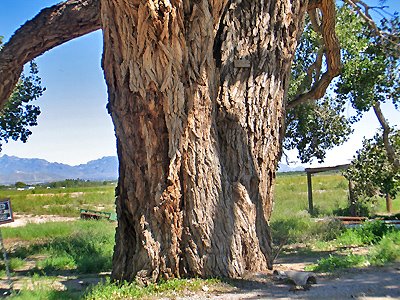


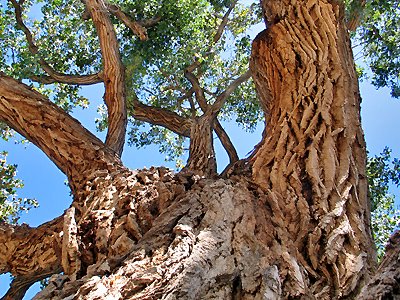

This tree has lived so long, survived so much — it should be recognized as the majestic living thing it is and protected. Vivat rex!
Tags: Oldest Tree, Mesilla
Wednesday, September 13th, 2006
Adobe Pulled Down
Yesterday afternoon, several miles south of Mesilla, I watched the last wall of an adobe structure pulled down. There were several good reasons the old home had to be demolished, including public safety.
Here’s the wall about to go: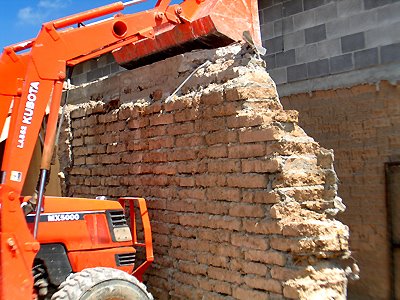
I spoke with the owner, who told me the structure was not that old, having been built about 1950.
How do you date adobe? Here’s one way: 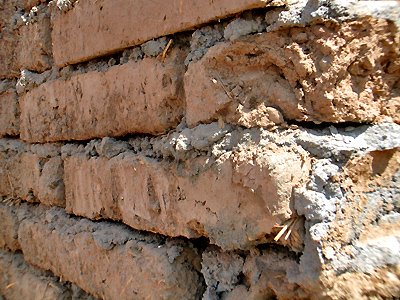
Notice that the mortar used between the adobe bricks is cement. That is a practice that began in the late 1940s and largely defeats the advantages of adobe, because cement is an excellent conductor of heat. An adobe structure that uses cement mortar instead of the traditional mud will be hotter in the summer and cooler in the winter.
Here’s the wall going down: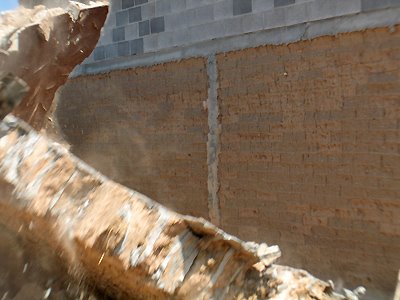
Tags: Adobe Wall
Saturday, September 9th, 2006
Thunderbird de la Mesilla
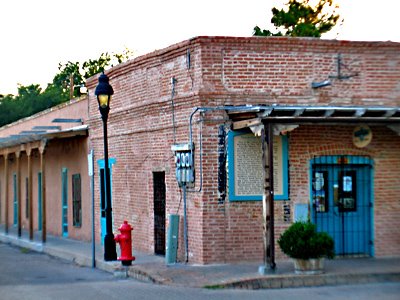
This is believed to be the oldest brick building in New Mexico. It sits at the southwest corner of Mesilla plaza. The sign on the front wall gives a quick history of the building.

“This is the oldest documented brick building in New Mexico.
Augustin Maurin (of French descent) initiated construction in 1860 using burned brick from his own kiln. He was murdered by robbers in his adjoining apartment in 1866.
The heir, Cesar Maurin, came here from France to claim the property. He died of natural causes in 1868.
Frenchman Pedro Duhalde, a former Mesilla saloonkeeper, moved in and was himself murdered by robbers.
Now owned by Tiburcio Frietze, after having been used as a general store, residence, saloon and town hall, the building remains in good condition.
Original, hand-hewn vigas, supporting a low, irregular ceiling, join with the old brickwork in creating a fitting background for the gift items displayed.
The Dona Ana Historical Society finds this building worthy of preservation and commends Mr. Frietze for his part in its care.”
Tags: Thunderbird de la Mesilla Gift Shop
Monday, September 4th, 2006
Old Mesilla Courthouse
The Old Mesilla Courthouse is now a gift shop.

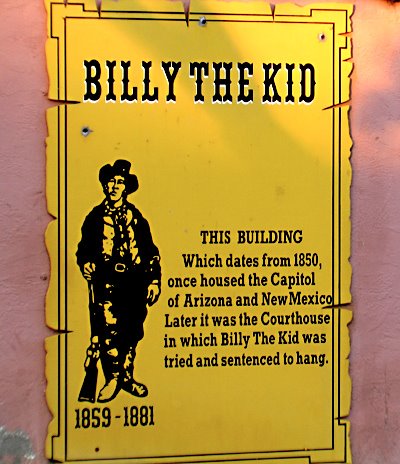
As indicated by the sign, the Courthouse dates from 1850.
Here’s a photo of the courthouse after it became the Elephant Butte Saloon, taken some time in the 1920s. The walls appear to be brick, but the bricks are painted, not real, except for the distinctive decorative brick along the roof, which you can see in both the old and the new photographs. Notice also that the corner of the building has been sliced off to make the current entrance.

See also:
Billy the Kid’s Grave
Did Billy the Kid Stay at La Posta in Mesilla?
Mesilla Museum Display
Billy the Kid Display – Mesilla
Saving the Pat Garrett Marker
Billy’s DNA
Billy the Kid
Thursday, August 31st, 2006
Billy the Kid
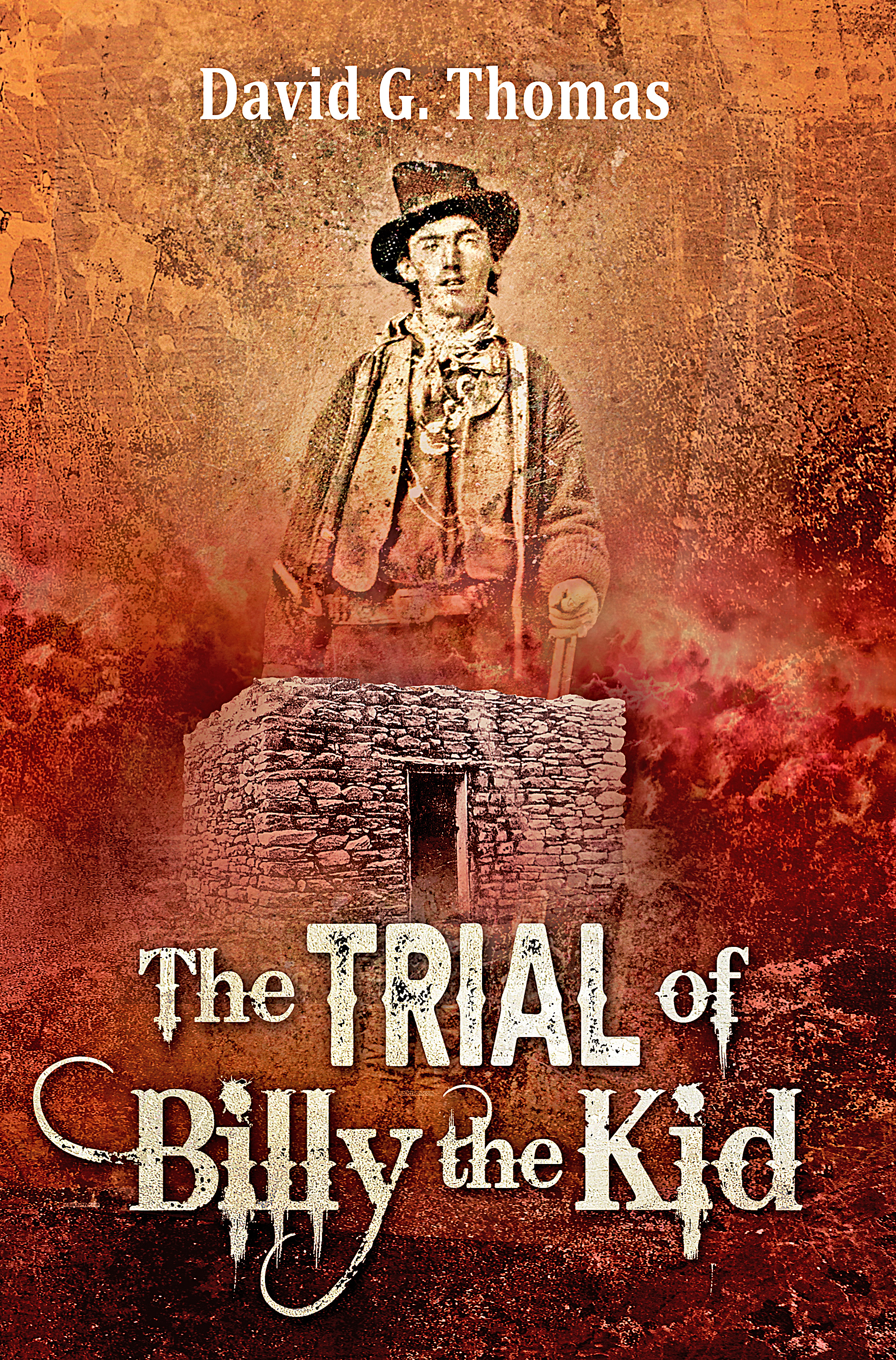
Still standing in the southeast corner of the Mesilla plaza is the courthouse and jail where Billy the Kid was tried and sentenced to death by hanging.
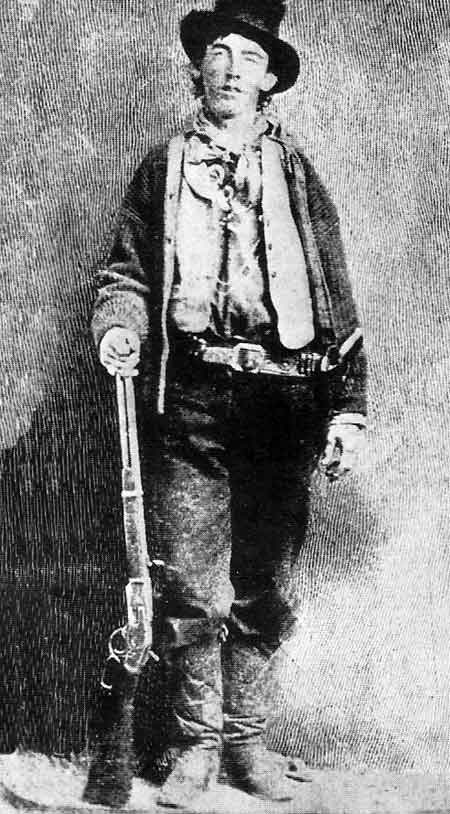
The only authentic picture of Billy.
Billy had been captured December 23, 1880.
On March 28, 1881, he was transported to Rincon by train and from there to Mesilla by wagon for trial for the murders of Andrew “Buckshot” Roberts and Sheriff William Brady. The indictment for killing Roberts was a federal indictment. The indictment for killing Brady was a territorial indictment. The territorial district court handled both jurisdictions, with the federal cases tried first.
His trial for killing “Buckshot” Roberts began on March 30, 1881. The case against him in this trial was thrown-out on the grounds that the killing took place on private land, not public land, and the federal government thus had no standing to prosecute.
The trial for the killing of Sheriff Brady began April 8. The judge presiding, Judge Bristol, dismissed Billy’s defense attorney from the Roberts trial, probably because of the change in jurisdiction, and appointed John D. Bail and Albert Fountain to represent him.
On April 13. the jury brought in its verdict: guilty. The judge then sentenced Billy to death by hanging, to be carried out on May 13, 1881 in Lincoln, New Mexico.
In an interview later that day in the Mesilla News, Billy said the following:
“Well, I had intended at one time to not say a word in my own behalf, because persons would say, ‘Oh, he lied’; Newman gave me a rough deal; has created prejudice against me, and is trying to incite a mob to lynch me. He sent me a paper which shows it; I think it a dirty, mean advantage to take of me considering my situation and knowing I could not defend myself by word or act. But I suppose he thought he would give me a kick down hill. Newman came to see me the other day; I refused to talk to him or tell him anything; but I believe the News is always willing to give its readers both sides of a question.”
“If mob law is going to rule, better dismiss judge, sheriff, etc., and let all take chances alike. I expected to be lynched in going to Lincoln. Advise persons never to engage in killing.”
Three days later he was taken to Lincoln. It was from the Lincoln courthouse that Billy escaped on April 28, killing two deputies.
See also:
Billy the Kid’s Grave
Did Billy the Kid Stay at La Posta in Mesilla?
Mesilla Museum Display
Billy the Kid Display – Mesilla
Saving the Pat Garrett Marker
Billy’s DNA
Old Mesilla Courthouse
Wednesday, August 30th, 2006
More on Gadsden Purchase
The Gadsden Purchase was signed in Mesilla on November 16, 1854. This is reflected in the Mexican name for the Purchase, the Treaty of Mesilla. A bronze plaque in the Mesilla plaza commemorates this agreement between the two countries.
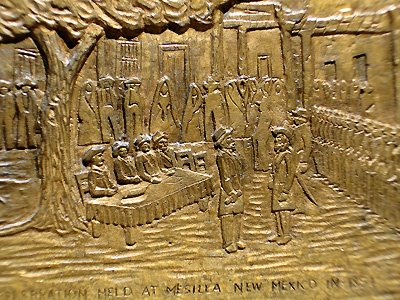
Following the signing of the treaty, the Mexican flag was lowered and the American flag raised. The people of Mesilla, who had previously been citizens of Mexico, became citizens of the United States. The agreements between Mexico and the inhabitants of the Gadsden Purchase area were respected by the US Government, including all land grants made by Mexico that were eventually adjudicated as valid.
Las Cruces, which today adjoins Mesilla, was just outside the Purchase area, being already part of the United States.
See also:
Rough and Ready — Butterfield Stage Stop
Tags: Mesilla Plaque
Saturday, August 26th, 2006
Mesilla History
Welcome to Mesilla.
It is generally accepted that the town of Mesilla was founded some time in the late 1840s, although it had been visited by various European travelers since the mid-1500s. Of course, Native Americans were familiar with this area and had camped here for thousands of years. They were not pleased to see settlers.
Mesilla means “little tableland.”
In 1851, Fort Fillmore was established to protect Mesilla from raids by Apaches.
In 1854, The Gadsden Purchase made Mesilla officially part of the United States. The treaty is named after the person who represented the United States in the negotiations with Mexico, James Gadsden.
With this treaty, Mexico sold the United States approximately 29,000 square miles of land for $10 million.

The map shows the location of the Purchase.
You can read the actual treaty here.
See also:
Rough and Ready — Butterfield Stage Stop
————-
Today Mesilla has a population of about 2400.
Tags: Old Mesilla History Gadsden Purchase